Why a Beach Changes Shape Along Its Length
Why a beach changes shape along its length: read the shoreline angle and incoming waves to understand why neighboring stretches gather or lose sand.
The most common mistake in reading a beach is treating its curve as one continuous, uniform surface. That can lead a walker to mistake a sheltered pocket for the beach’s general condition, or to assume that a broad stretch will continue around the next headland. Why a beach changes shape along its length often comes down to a local difference in shoreline angle and the direction waves approach.
A walk with two beaches
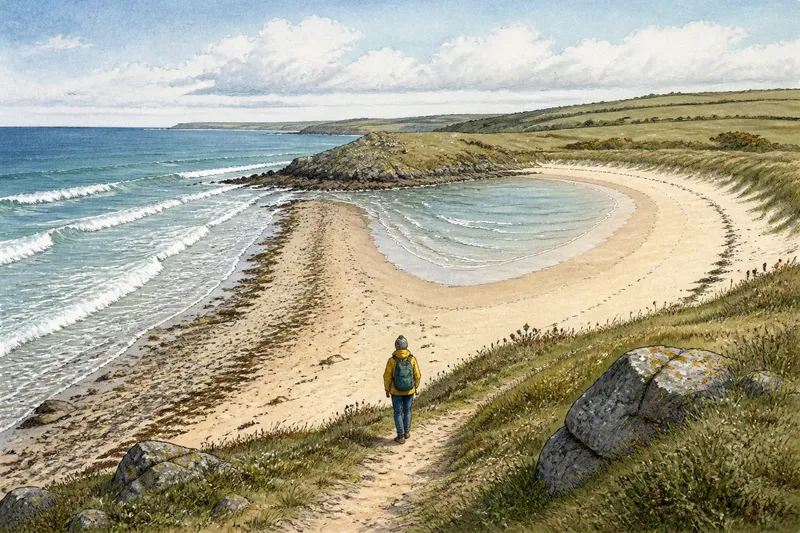
Imagine a hypothetical stretch of coast called Alder Strand. It is not a real place. At its western end, the beach runs almost straight toward the open water. Farther east, it bends into a shallow arc behind a low rocky point. There is no seawall between the two sections, and the sand appears continuous at low tide.
After a spell of waves arriving from the southwest, a walker notices that the western stretch has a narrow, uneven upper beach. The eastern arc looks broader and smoother, with a small ridge of sand near its sheltered end. The tempting explanation is that the eastern part simply has more sand. A closer look at the coast’s orientation offers a more useful account.
The western shore faces the incoming waves more directly. The eastern curve turns away from them. The same wave train therefore reaches each section at a different angle and with different exposure. The change in shape is not a neat boundary; it is a gradual shift in how water and sediment interact along the coast.
Angle changes the approach
A wave usually travels toward shore along a line set by conditions offshore. Where that line meets a beach at an angle, water can run diagonally up the slope, carrying loose sand with it. As the water drains back down, it tends to follow the steeper route of the beach face. Repeated swash and backwash can move grains along the shore in a series of short, slanted transfers.
At Alder Strand’s western end, the shore’s alignment makes the incoming waves strike at a more oblique angle. The diagonal rush of water is more apparent there. Along the curved eastern section, the local shoreline direction changes, so waves meet it less obliquely and may lose some force behind the point. The result can be different patterns of sand movement only a short walk apart.
This does not mean every angled wave pushes sand in one lasting direction. Wave direction, water depth, sand size, and the shape of the nearshore bottom all affect what happens. A passing change in wind or swell can alter the pattern. The useful observation is comparative: note how the wave fronts meet each stretch, rather than assuming the coast has one fixed angle.
Exposure sorts the sand
The rocky point at Alder Strand partly interrupts waves reaching the eastern arc. It does not block the sea completely, but it changes the energy reaching the sand. In the more exposed western section, stronger uprush may shift loose grains and leave a steeper or more irregular face. In the calmer pocket, finer sand can settle more readily, while the beach may build a low ridge or a rounded profile.
Those are tendencies, not a promise of a particular profile. A sheltered pocket can still erode when conditions change, and an exposed beach can gain sand if waves bring material in. Beach shape reflects the balance between sediment arriving, sediment leaving, and sediment being shifted within the same stretch.
At the point where Alder Strand bends, the contrast is especially visible. The sand may narrow where flow is directed around the headland, then collect in a quieter curve beyond it. Such a pattern can suggest how waves and sediment are moving, but a single visit cannot establish whether the beach is gaining or losing material over time.
Read the signs in place
To compare neighboring stretches, use landmarks that stay put: a rock outcrop, a footpath entrance, or a line of coastal plants set back from the sand. Look at the beach face, the upper edge where debris gathers, and the way wave fronts arrive. A phone photograph taken from the same safe viewpoint on separate visits can help you notice changes without relying on memory.
- Shore alignment: Does the beach face the open water, or curve away from the prevailing approach?
- Wave angle: Do wave fronts arrive squarely, or run diagonally along the shore?
- Exposure: Is a point, reef, or offshore bar interrupting some of the wave energy?
- Sand texture: Does one section look coarser, finer, or more mixed than its neighbor?
- Beach profile: Is the upper beach steep, gently sloped, ridged, or cut by small channels?
- Repeat observations: Are the same landmarks showing a persistent change, or just a different surface after recent conditions?
Say you visit Alder Strand after a change in the direction of the swell. The western beach now has smaller, more direct breakers, while waves wrap around the point and reach the eastern arc from a new angle. You record the shoreline at the same rock outcrop and notice that the eastern ridge is less distinct. That observation suggests a changed local pattern, not a definite loss of sand; a later visit can show whether the difference persists.
Questions about beach shape?
Why does one end look wider?
A curved or sheltered section may receive less wave energy and allow sand to settle, while a more exposed section shifts more often. The difference may also reflect sediment arriving from elsewhere, so width alone does not identify the cause.
Can waves move sand sideways?
Yes. When waves approach at an angle, swash can carry sand along the beach, while backwash returns downslope. The net movement varies with the wave approach and local conditions, and can change direction.
Does a headland always shelter a beach?
A headland can reduce exposure from some directions, but waves may wrap around it or arrive from another direction. Its effect depends on the shape of the coast and the direction of incoming waves.
Can one visit show a long-term change?
One visit shows the beach’s condition at that moment, not its longer pattern. Repeat views from consistent landmarks help separate a lasting shift from a temporary response to recent waves.
Keep the comparison local
Alder Strand’s invented walk shows why a beach should be read section by section. Shoreline angle influences how waves meet the sand; nearby points and curves alter exposure; and sediment responds to both. Those influences overlap, so the beach rarely divides into simple zones with crisp edges.
When asking why a beach changes shape along its length, compare adjacent stretches under similar conditions and describe what you can see before explaining it. A wave approaching at an angle, a sheltered curve, or a shifting sand ridge is useful evidence to notice. Treat each as a clue to local movement, not as a verdict on the whole coast.